30-Question Evaluative Exam
All 8 Course Disciplines
Instant Scholarly Citations
Full Andalusian Scientific Dictionary
Course Mastery Examination & Compendium
Test your comprehensive knowledge across all modules: History, Euclid & Algebra, Optics, Girih Tilings, Architecture, Mudéjar Synthesis, Calligraphy, and Astrolabes. Select your answers below for immediate academic validation and source citations.
Andalusian & Arabic Scientific Glossary
Al-Khaṭṭ al-Mansūb (الخط المنسوب)
The proportioned system of Arabic calligraphy formulated by Ibn Muqla in the 10th century, based on the rhombic dot (Nuqta), the standard Alif, and circumscribed circles.
Alicatado & Azulejos
Polychrome ceramic mosaic tilework characteristic of Andalusian and Mudéjar architecture, created by cutting glazed ceramic tiles into precise geometric polygons and assembling them into intricate strapwork.
Artesonado
A Spanish architectural term for magnificent coffered timber ceilings decorated with interlacing geometric woodwork (armaduras de lazo), crafted primarily by Mudéjar artisans.
Astrolabe (الأسطرلاب)
An astronomical analogue computer used for solving problems relating to timekeeping, celestial coordinates, navigation, and surveying via stereographic projection.
Bayt al-Ḥikma (بيت الحكمة)
The House of Wisdom in Abbasid Baghdad: a premier library, translation bureau, and academy where Greek, Syriac, Persian, and Sanskrit scientific texts were translated into Arabic.
Girih (گره / جِرِيح)
Arabic geometric strapwork composed of interlacing lines that form star polygons and tessellations, constructed using a specific set of 5 self-similar polygon tiles.
Muqarnas (مقرنص)
Architectural honeycomb or stalactite vaulting composed of small, stepped, corbeled niche units arranged in tiered three-dimensional geometric projections.
Nuqṭa (نقطة)
The rhombic dot produced by resting the square-cut nib of a reed pen (Qalam) at an angle of ~45 degrees, serving as the universal unit of measurement in calligraphy.
Saphaea Arzachelis (الصفيحة الزرقالية)
The universal astrolabe invented by Al-Zarqālī of Toledo in the 11th century, functioning universally across all latitudes without interchangeable geographic plates.
Yesería
Elaborately carved gypsum plasterwork and stucco relief used in Arabic and Mudéjar architecture to decorate walls, arches, and friezes with epigraphy, arabesques, and geometric motifs.
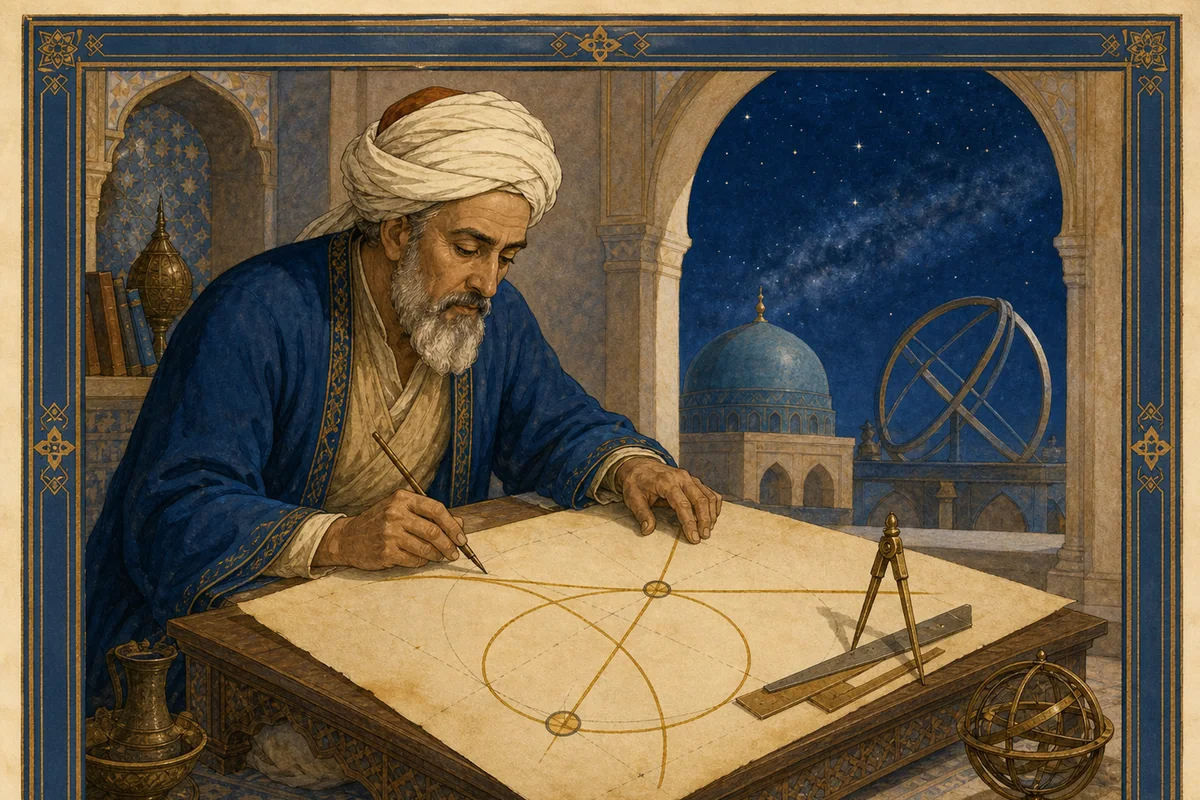
All course illustrations are original works created for The House of Geometry.