Al-Khwarizmi, Alhazen, Abu al-Wafa
Algebraic Geometry, Ray Optics, Conics
Disproof of Extramission → Intromission
Compass & Straightedge constructions
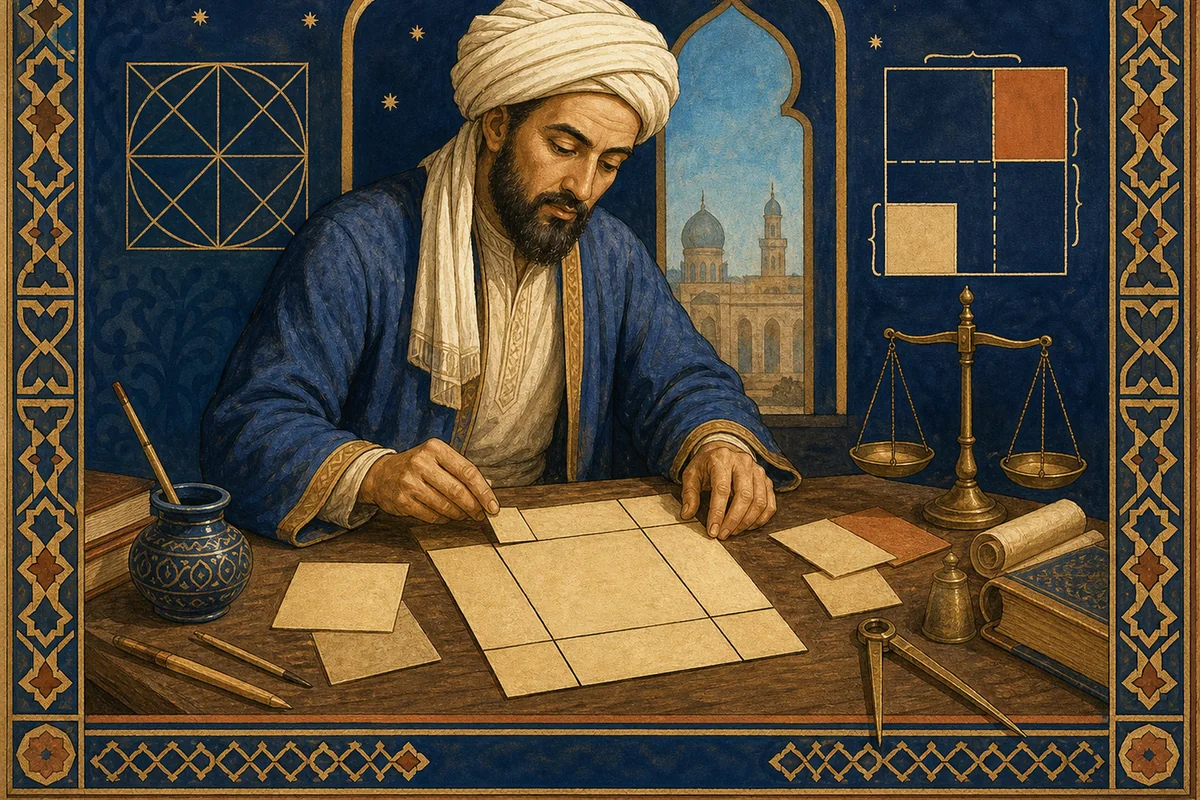
1. Al-Khwārizmī: The Geometric Foundations of Algebra
When Muḥammad ibn Mūsā al-Khwārizmī wrote al-Kitāb al-mukhtaṣar fī ḥisāb al-jabr wa-l-muqābala (c. 820 CE), he did not simply provide numerical algorithms; he provided rigorous geometric proofs of quadratic equations based on Euclidean area transformations.
2. Ibn al-Haytham (*Alhazen*): Optics as Physical Geometry
In Cairo under the Fatimids, Al-Ḥasan Ibn al-Haytham (c. 965–1040 CE) composed his masterpiece Kitāb al-Manāẓir (De Aspectibus / Book of Optics), fundamentally altering the history of physics.
Intromission Theory of Light
Definitively disproved the Euclidean/Ptolemaic belief that the eye emits visual rays. Proved experimentally that luminous rays originate from light sources, reflect off objects in all directions, and enter the pupil along rectilinear paths.
Camera Obscura (*Al-Bayt al-Muzlim*)
Constructed the first formal optical pinhole chamber to demonstrate the rectilinear propagation and inversion of light rays during solar eclipses, proving that every point on a light source illuminates every point on a screen through a tiny aperture.
"Alhazen's Problem" in Conics
Solved the famous catoptric problem: Finding the point on a spherical mirror where a ray from a fixed source must reflect to reach an observer's eye. This required intersecting a circle with an equilateral hyperbola, an early breakthrough in non-Euclidean analytical geometry.
3. Abū al-Wafāʾ al-Būzjānī: Applied Geometry for Artisans
In Fī mā yaḥtāju al-ṣāniʿ min aʿmāl al-handasa ("On Those Parts of Geometry Needed by Craftsmen"), Abū al-Wafāʾ provided compass-and-straightedge constructions for dividing circles into 5, 7, and 10 equal parts, constructing regular polyhedra, and dissecting geometric squares into mosaic tiles without measurement error.
All course illustrations are original works created for The House of Geometry.