Girih Strapwork & Tilings
5 Shapes: Decagon, Pentagon, Diamond, Bowtie, Hexagon
8-Fold, 10-Fold, 12-Fold Star Rosettes
500-Year Anticipation of Penrose Tilings
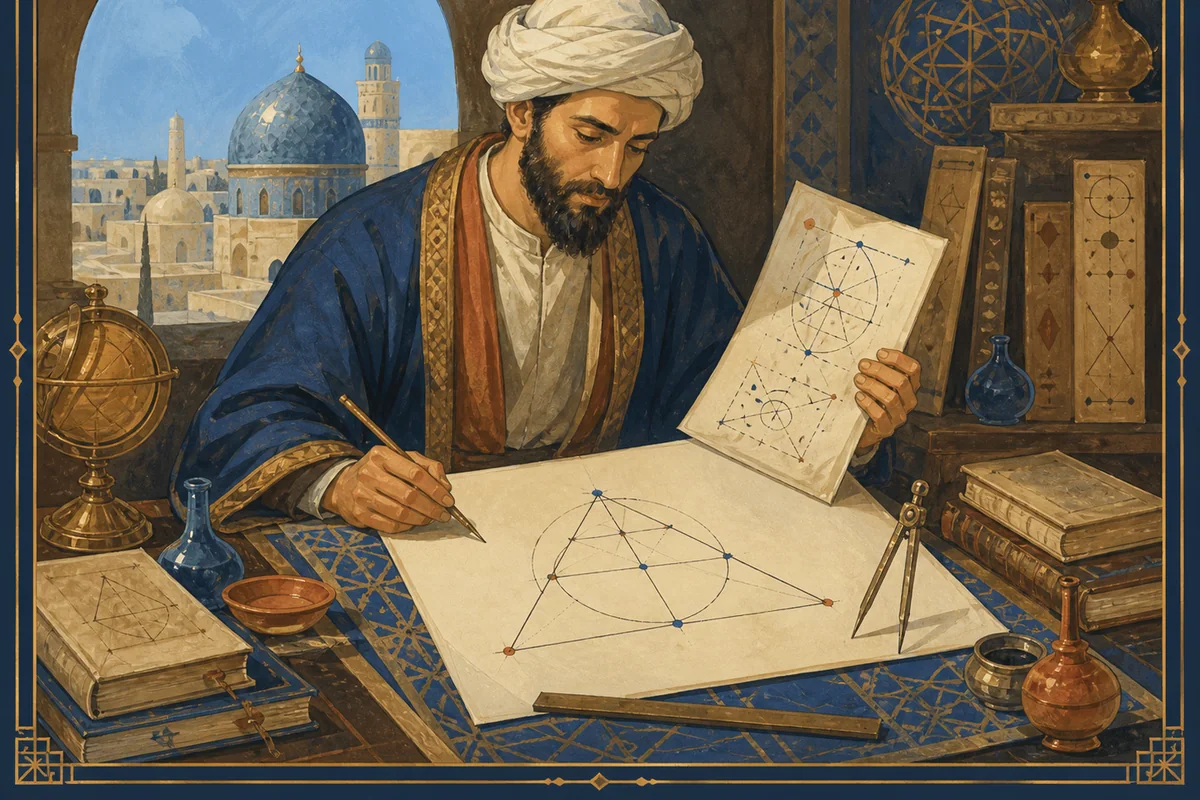
1. The Mathematics of Girih Strapwork
Girih (Arabic: جِرِيح, Persian: گره, meaning "knot") refers to the complex interlacing geometric strapwork adorning Arabic architecture across Andalusia, North Africa, Persia, and the Levant. While appearing dauntingly intricate, the entire system is governed by rigorous mathematical principles.
2. The Five Canonical Girih Tiles
| Tile Shape | Internal Angles | Internal Line Decorations | Structural Role in Tessellation |
|---|---|---|---|
| Regular Decagon | Ten angles of 144° | 10-pointed star rosette formed by intersecting strap lines | Primary central hub; anchors 10-fold rotational symmetry nodes. |
| Regular Pentagon | Five angles of 108° | 5 internal strapwork segments radiating from midpoints | Surrounds decagons to mediate rotational progression. |
| Diamond (Rhombus) | Angles of 72° and 108° | Crossed internal strapwork connecting opposite edges | Fills intermediate seams and creates star points. |
| Bowtie (Non-Convex Hexagon) | Four angles of 72° and two reflex angles of 216° | Interlacing butterfly pattern connecting edge centers | Locks decagons together at non-periodic boundary intervals. |
| Elongated Hexagon | Four angles of 144° and two angles of 72° | Continuous horizontal and diagonal ribbons | Extends patterns linearly across architectural friezes. |
3. Step-by-Step Compass Construction of an 8-Fold Star
The Circumscribed Circle & Perpendicular Axes
Draw a circle with radius $R$. Draw perpendicular horizontal and vertical diameters through center $O$ to establish the primary cardinal points $N, S, E, W$.
Bisect Quadrants for the Diagonal Axes
Bisect each 90° quadrant using compass arcs from $N, E, S, W$ to generate the 45° diagonal axes ($NE, NW, SE, SW$), dividing the circumference into 8 equal arcs of 45°.
Inscribe Two Overlapping Squares
Connect alternating division points to draw two identical squares rotated by 45° relative to each other (the Khatam / Eight-Pointed Star of Al-Andalus).
Extend Rays & Apply Strapwork Width
Parallel offset each line segment by $\pm w/2$ to create physical ribbons. Alternate "over" and "under" crossings at every intersection to render continuous interlaced depth.
All course illustrations are original works created for The House of Geometry.