Mezquita (Cordoba), Alhambra (Granada)
3D Modular Muqarnas (Honeycomb)
Polylobed, Interlacing, Horseshoe
All 17 2D Wallpaper Symmetry Groups
1. The Great Mosque of Córdoba (*La Mezquita*)
Founded in 785 CE by Abd al-Raḥmān I and expanded across two centuries, the Mezquita is one of the supreme achievements of world architecture, introducing revolutionary structural and spatial solutions.
Two-Tiered Arch Superposition
To achieve grand ceiling height with slender Roman/Visigothic spolia columns, architects placed stone piers atop lower horseshoe arches, carrying upper semicircular arches that braced the cedar timber roof.
Bichrome Voussoirs
Alternating red brick and white limestone voussoirs (*dovelas*) not only created a dazzling visual cadence but provided structural elasticity against seismic tremors.
Ribbed Domes of the Maqṣūra
Constructed in 965 CE under Al-Ḥakam II, the square bay in front of the Miḥrāb is spanned by an octagonal framework of intersecting stone ribs that leave the center open, prefiguring Gothic ribbed vaulting by nearly two centuries.
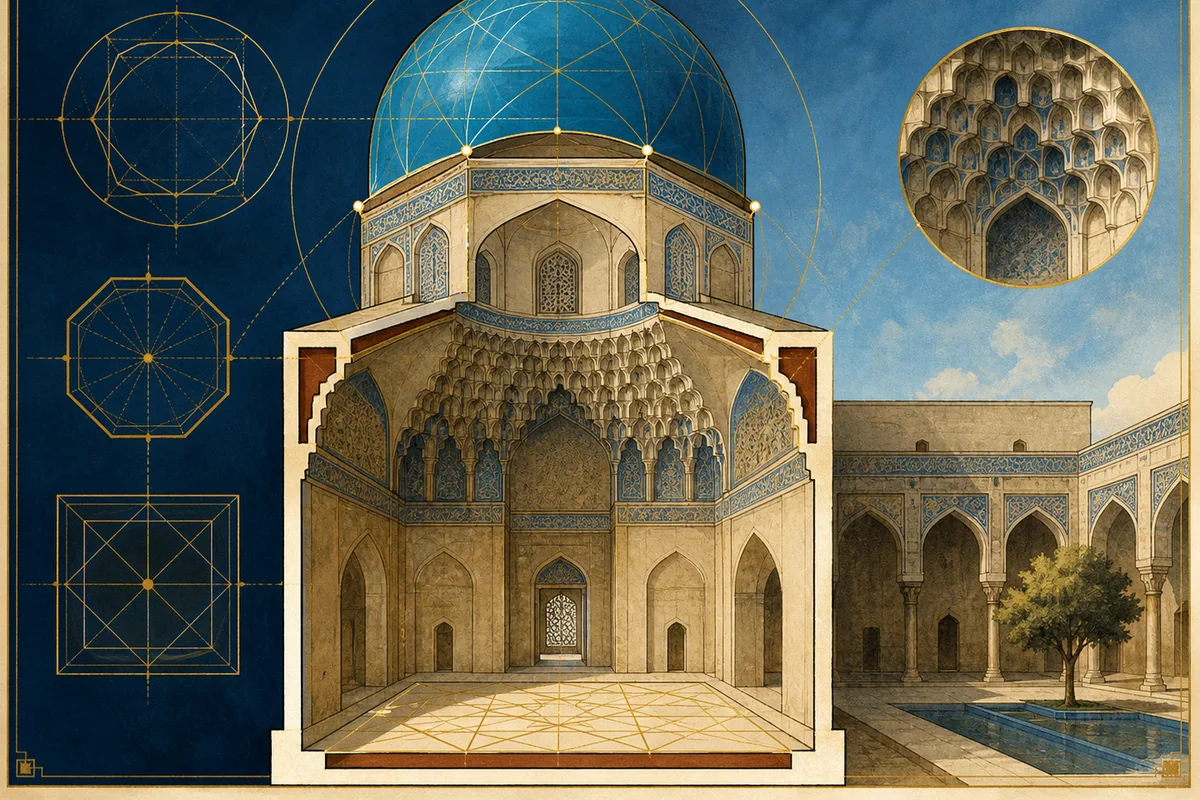
2. Muqarnas: 3D Geometrical Corbel Vaulting
Muqarnas (Arabic: مقرنص), often called "stalactite" or "honeycomb" vaulting, is a uniquely Arabic architectural device that transitions square or rectangular walls into circular domes using hundreds of small, tiered, corbeled niche components.
3. The 17 Wallpaper Symmetry Groups in the Alhambra
In 2D planar mathematics, there are exactly 17 distinct crystallographic wallpaper groups (mathematical symmetry classes that can tile a flat surface indefinitely via translations, rotations, reflections, and glide reflections). Mathematicians Marcus du Sautoy, Branko Grünbaum, and Edith Müller proved that Nasrid artisans in the Alhambra intuitively mastered and represented all 17 wallpaper symmetry groups across their mosaic tilings and plaster friezes.
All course illustrations are original works created for The House of Geometry.