Planispheric & Universal Astrolabe
Al-Zarqālī (Arzachel, 1029–1087 CE)
Stereographic Conformal Projection
Toledan & Alfonsine Astronomical Tables
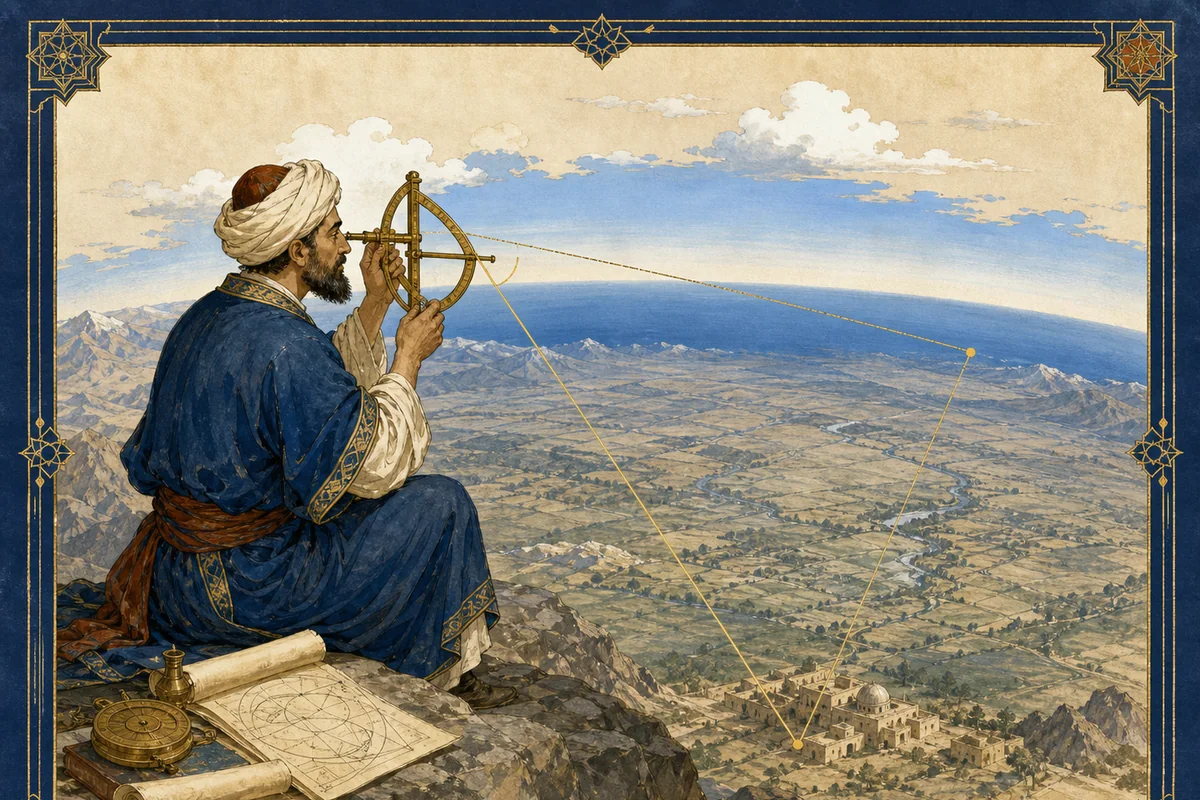
1. The Astrolabe: Medieval Analogue Computer
The planispheric astrolabe (Arabic: الأسْطُرْلاب) was the most sophisticated observational and mathematical instrument of antiquity and the Middle Ages. It uses stereographic projection to map the 3D celestial sphere onto a 2D plane, preserving circles and angles perfectly (conformal mapping).
Interactive Star Rete & Horizon Grid
Click and drag inside the astrolabe or use the slider below to rotate the openwork Rete (Spider) over the fixed climate plate. Observe how star pointers (Vega, Sirius, Aldebaran) revolve around the celestial north pole and track relative to the golden horizon arc.
• Mater (Outer Brass Ring): Engraved with 24 hours and 360 degrees.
• Tympan (Climate Plate): Shows altitude lines (Almucantars) for Lat 37.8° (Cordoba/Toledo).
• Rete (Web): Features the off-center Zodiac circle and star pointers.
2. Al-Zarqālī (*Arzachel*) & The Universal Saphaea of Toledo
In 11th-century Toledo, Abū Isḥāq Ibrāhīm al-Zarqālī revolutionized astronomical instrumentation by inventing the al-Ṣafīḥa al-Zarqāliyya (known in Latin as the Saphaea Arzachelis). Unlike standard astrolabes which required changing plates for each latitude, Al-Zarqālī's instrument projected the heavens from the vernal equinox onto the solstitial colure plane, creating the world's first universal astrolabe usable anywhere on Earth.
The Toledan Astronomical Tables
Al-Zarqālī led an observatory team in Toledo that compiled the Toledan Tables (c. 1080 CE), determining planetary motions, lunar eclipses, and trigonometric values with unprecedented precision.
King Alfonso X's Alfonsine Tables (1252)
Christian King Alfonso X convened Jewish and Arab astronomers in Toledo (including Yehuda ben Moshe and Isaac ibn Sid) to update the Toledan Tables, producing the standard tables used by Christopher Columbus and Copernicus.
All course illustrations are original works created for The House of Geometry.