8th – 13th Century CE
Baghdad, Cordoba, Toledo, Cairo
Hunayn, Gerard of Cremona, Ibn Daud
Toledo School of Translators
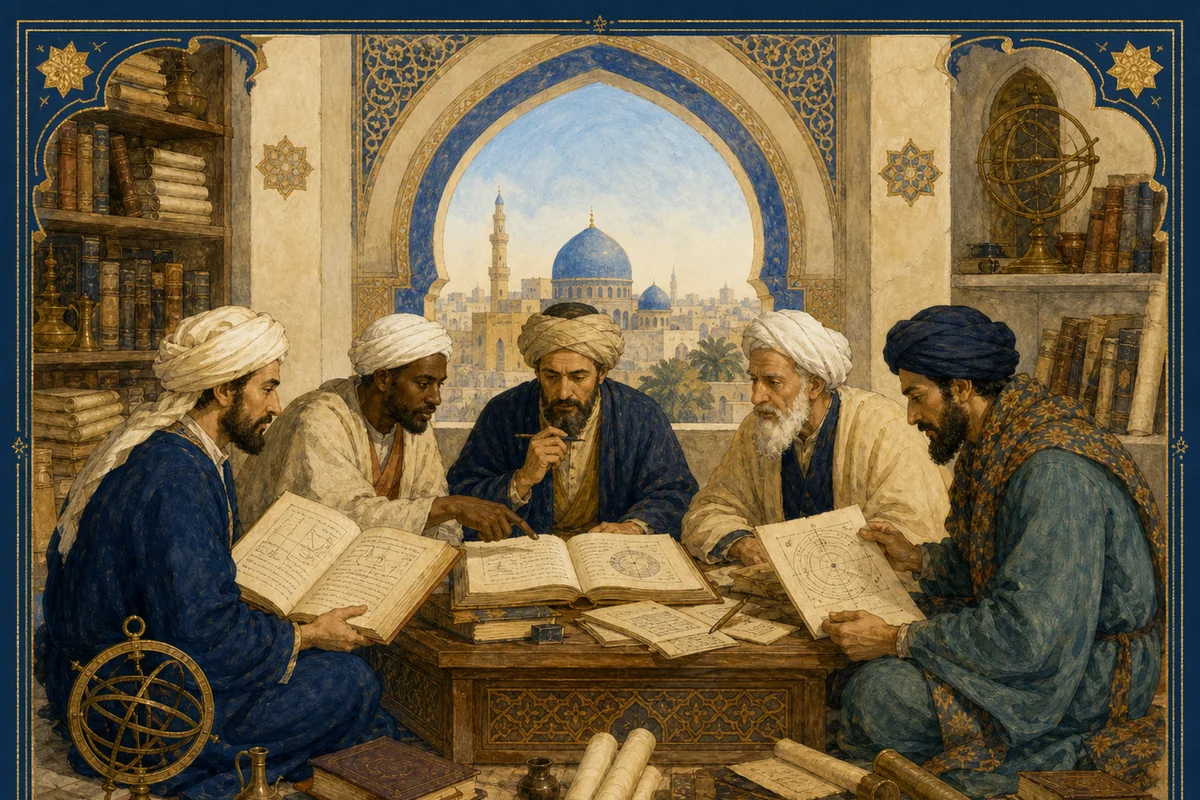
1. Baghdad's Bayt al-Ḥikma & The Translation Canon
The scientific flourishing of the medieval Mediterranean began in the early 9th century in Abbasid Baghdad with the establishment of Bayt al-Ḥikma (The House of Wisdom). Under Caliphs Hārūn al-Rashīd and al-Ma'mūn, an organized state-sponsored effort was launched to locate, translate, and annotate classical Greek, Syriac, Sanskrit, and Pahlavi manuscripts into Arabic.
Ḥunayn ibn Isḥāq (808–873 CE)
Chief translator at Bayt al-Hikma and a Nestorian Christian polymath who mastered Arabic, Syriac, Greek, and Persian. He revolutionized translation methodology by collating multiple Greek manuscripts to create a clean archetype before translating into Syriac and Arabic.
Thābit ibn Qurra (826–901 CE)
Sabian mathematician from Harran who translated Euclid's Elements, Apollonius's Conics, Archimedes' works, and Ptolemy's Almagest, while formulating original theorems on amicable numbers and spherical trigonometry.
2. The Toledo School of Translators (12th–13th Century)
Following the fall of Toledo to King Alfonso VI of Castile in 1085, Toledo became the intellectual crossroads of Western Europe. Archbishop Raymond of Toledo (served 1125–1152) and later King Alfonso X "El Sabio" (reigned 1252–1284) organized collaborative translation colleges.
| Scholar | Origins / Working Circle | Major Translated Works into Latin / Romance | Significance for European Science |
|---|---|---|---|
| Gerard of Cremona (c. 1114–1187) | Italian polymath resident in Toledo | Ptolemy's Almagest, Euclid's Elements, Al-Khwārizmī's Algebra, Ibn Sīnā's Canon of Medicine, Al-Zarqālī's Toledan Tables | Translated over 87 works; single-handedly formed the core curriculum of early European universities (Paris, Oxford, Bologna). |
| Dominicus Gundissalinus | Archdeacon of Cuéllar (Castile) | Ibn Gabirol's Fons Vitae, Al-Ghazālī's Maqāṣid al-Falāsifa, Al-Fārābī's On the Sciences | Integrated Arabic epistemology and metaphysics into Latin scholasticism. |
| Abraham Ibn Daud (Avendauth) | Toledan Jewish Philosopher & Historian | Collaborated with Gundissalinus on Avicenna's De Anima | Provided vernacular Castilian oral bridge translations from Arabic that Gundissalinus then recorded in Latin. |
| Michael Scot (1175–1232) | Scottish scholar in Toledo & Sicily | Averroës (Ibn Rushd)'s Commentaries on Aristotle, Al-Biṭrūjī's On the Spheres | Transmitted Aristotelian-Averroistic philosophy to the court of Holy Roman Emperor Frederick II. |
All course illustrations are original works created for The House of Geometry.